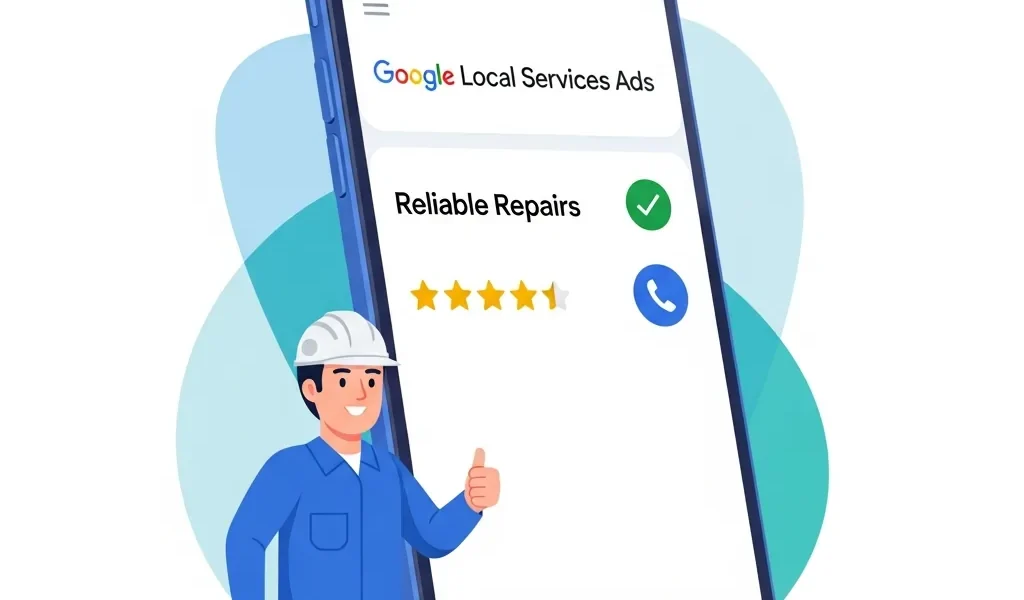
If you run a trade or home-service business in the UK, Local Services Ads are the slot at the very top of Google that put your phone number in front of people who are ready to book. They work on a pay-per-lead model rather than pay-per-click, which changes the maths in your favour when it is set up properly.
What are Local Services Ads?
Local Services Ads (often shortened to LSAs) are a distinct Google advertising product built for service businesses that travel to the customer or serve a defined local area. They sit above the standard Search ads and above the map pack, showing your business name, review score, a trust badge, and a way to contact you directly. The single biggest difference from a normal Google Ads campaign is the billing model: you are charged for a genuine lead (a phone call or message that comes through the ad), not for every click. For a plumber or electrician, that means you only pay when someone actually reaches out about a job, not when a browser taps your listing and bounces.
Local Services Ads also carry a verification badge that a standard search ad cannot. Home-service categories earn the Google Guaranteed badge, and professional-service categories earn Google Screened. Both signal to a nervous customer that Google has checked the business, and that reassurance is a large part of why these ads convert. Google's own eligibility and setup guidance for the UK is the authoritative reference, and it is worth reading before you commit budget: see the official Getting started with Local Services Ads help page.
Why Local Services Ads work for local businesses
The format is deliberately stripped back. There are no keywords to research, no landing pages to build, and no ad copy to write. Google matches your business to nearby searches based on your categories, service area, and reviews, then charges you per lead. For an owner-operator who would rather be on the tools than in an ads dashboard, that simplicity is the appeal. Here is what makes the format effective.
Top-of-page placement
LSAs appear above every other paid and organic result for eligible local queries, so your business is the first thing a ready-to-buy customer sees.
You pay per lead, not per click
Charges land only when someone calls or messages about your service. Idle curiosity and misclicks do not cost you anything.
The Google Guaranteed badge
For home-service categories, the green tick and money-back guarantee reassure first-time customers who have never heard of you.
Reviews do the selling
Your star rating and review count sit right in the ad, so a strong reputation directly lifts both ranking and click-through.
Genuinely simple to run
No keywords, landing pages, or creative. You set a weekly budget, confirm your categories, and respond to leads as they arrive.
Bad leads can be credited
Leads that fall outside your service or area can be flagged for a credit, so you are not stuck paying for irrelevant enquiries.
Google Guaranteed vs Google Screened: which badge you get
The badge you qualify for depends on your industry, and it is not a choice you make. Home-service trades such as plumbers, electricians, heating engineers, locksmiths, cleaners, and roofers fall under Google Guaranteed. To earn it, the business passes checks that can include licence verification (where a licence applies), insurance confirmation, and background checks on the business and its field staff through Google's screening partner. In return, Google backs qualifying jobs booked through the ad with a money-back guarantee to the customer, up to a lifetime cap. That guarantee is Google's, not yours, and it is a powerful trust signal for a homeowner letting a stranger into the house.
Professional services, where they are eligible, earn Google Screened instead. The verification is similar in spirit but there is no money-back guarantee attached, because the risk profile is different. Whichever badge applies, the underlying point is the same: the customer sees that Google has vetted you, and that lowers the resistance to picking up the phone.
How much do Local Services Ads cost in the UK?
Because you pay per lead, the number that matters is cost per lead, not cost per click. UK lead prices vary widely by trade and location, and Google adjusts them based on demand. A single lead can run from a few pounds in a low-competition category to well over thirty pounds in a competitive city trade. You control spend by setting a weekly budget, which is an average rather than a hard daily ceiling: Google may spend more on a busy day and less on a quiet one, but it will not exceed the monthly equivalent of your weekly figure.
The honest way to judge cost is to work backwards from your numbers. If your average job is worth 400 pounds, your close rate on LSA leads is one in three, and leads cost 20 pounds each, then three leads cost 60 pounds to win one 400-pound job. That is the calculation to run before you scale. It is a very different shape from a pay-per-click budget, and if you want to compare the two properly it helps to understand how much standard Google Ads cost in the UK alongside your LSA lead prices. The two models suit different goals, and plenty of businesses run both.
How to set up Local Services Ads: a step-by-step overview
Setup is more admin than marketing. The bottleneck is verification, not campaign building, so start early and have your documents ready.
- Check eligibility. Confirm your business type and location are supported. Categories expand over time, so verify current availability rather than relying on an old list.
- Create your profile. Enter your business details, service categories, service area, and business hours. Accuracy here affects which searches you match.
- Complete verification. Submit your business registration, proof of insurance, any required licences, and consent to background checks. This is the step that takes days to weeks, so plan for it.
- Connect your reviews. Link your Google Business Profile so your existing review score and count feed into the ad. Reviews influence both ranking and conversion.
- Set your budget and lead preferences. Choose a weekly budget and, where available, the types of jobs and hours you want leads for.
- Go live and respond fast. Once approved, leads arrive as calls and messages. Answer them quickly, because responsiveness feeds directly back into your ranking.
None of these steps require the keyword and bidding knowledge that a search campaign does. If you have ever wrestled with match types and quality score, you will find LSAs refreshingly light. For context on the more technical alternative, our explainer on how pay-per-click works shows what standard Google Ads asks of you by comparison.
How Google ranks Local Services Ads
Only a handful of businesses show in the LSA unit at once, so ranking within it matters. Google has not published a formula, but the signals that consistently move the needle are well understood:
- Review score and volume. A higher rating and more recent reviews lift you above thinner competitors.
- Responsiveness. How quickly and reliably you answer leads. Missed calls hurt.
- Proximity. How close you are to the searcher within your declared service area.
- Business hours. You are more likely to show when you are open and able to take the job.
- Complaints and disputes. A pattern of customer complaints, or excessive lead disputes, can suppress how often you appear.
The practical takeaway is that your reputation and your phone habits are your ad optimisation. There is no clever bid adjustment that outranks simply answering the phone and collecting good reviews.
Are Local Services Ads worth it? An honest assessment
For the right business, LSAs are one of the highest-intent lead sources on Google. Someone who taps a Local Services Ad is actively looking to book a plumber, not researching a topic. The pay-per-lead model aligns cost with outcome, and the Google Guaranteed badge converts cautious first-time customers better than a plain listing ever could. Cleaning and trade businesses regularly report that LSA leads close at a higher rate than clicks from standard search.
There are real drawbacks to weigh honestly. Lead quality is not perfect: you will get the occasional wrong-number, out-of-area, or misfiled enquiry, and while these can be flagged for credit, the process is now largely automated and credits are not guaranteed. You have less control than in a search campaign, because you cannot write the ad or choose exact keywords. Verification can be slow, and in very competitive city categories lead prices climb. LSAs also only cover eligible service categories, so they are not an option for every business. Weighed up, the format rewards businesses with strong reviews, fast phone response, and a service worth guaranteeing, and it frustrates those hoping to set it and forget it. If you would rather hand the whole thing over, a Google Ads agency can manage verification, lead disputes, and the wider paid strategy around it.
Local Services Ads vs standard Google Search Ads
These are complementary tools, not rivals. Local Services Ads win on trust and simplicity for local service jobs: top placement, a verification badge, and pay-per-lead billing with almost no setup. Standard Search Ads win on control and reach: you choose keywords, write the copy, send traffic to a landing page, and can advertise anything, not just eligible service categories. A trade business chasing local bookings often starts with LSAs for the highest-intent leads, then layers standard Search Ads underneath to capture the searches LSAs do not cover, such as specific product queries or jobs outside the LSA category list. Used together, the LSA unit and a well-run search campaign cover both the trust-led and the intent-led parts of the same customer journey. Our Google Ads management service runs both sides of that setup for UK service businesses.
Frequently asked questions
What are Local Services Ads and how do they differ from normal Google Ads?
Local Services Ads are a pay-per-lead advertising product that shows service businesses at the very top of Google with a verification badge. Unlike normal Google Ads, you are charged per genuine lead (a call or message) rather than per click, and there are no keywords or landing pages to manage.
Are Local Services Ads available in the UK?
Yes. LSAs are live in the UK across a growing list of home-service and professional categories. Availability depends on your specific industry and location, so check current eligibility on Google's official Local Services Ads help pages before you sign up.
How much does a Local Services Ad lead cost?
Lead prices vary by trade, competition, and location, ranging from a few pounds to more than thirty pounds per lead in busy city categories. You control spend with a weekly budget, and the figure that matters is cost per lead measured against your average job value and close rate.
What is the Google Guaranteed badge?
Google Guaranteed is the green tick shown on home-service Local Services Ads for businesses that pass Google's verification checks. It comes with a money-back guarantee from Google to the customer, up to a lifetime cap, which reassures first-time customers and lifts conversion.
Can I get a refund for a bad Local Services Ads lead?
You can flag leads that fall outside your service or area for a credit. Be aware that the review is now largely automated and credits are not guaranteed, so it pays to keep your categories and service area tightly defined to reduce irrelevant leads in the first place.
Do I still need standard Google Ads if I run Local Services Ads?
Often yes. LSAs capture the highest-intent local jobs in eligible categories, but standard Search Ads let you target specific keywords, products, and areas that LSAs do not cover. Many UK service businesses run both so that the two formats complement rather than compete with each other.