Answer engines now sit between your website and a large share of your buyers, and most UK businesses have no idea whether they appear in those answers at all. An answer engine optimisation audit is how you find out, and you can run the first pass yourself in an afternoon without buying a single tool.
What an answer engine optimisation audit actually measures
An answer engine optimisation audit measures one thing: whether ChatGPT, Google's AI Overviews, Perplexity, Copilot and Gemini can reach your content, understand it, trust it enough to reuse it, and name you when they do. That is a different question from "do we rank", and it fails in different places. A page can sit at position three in classic Google results and still never be cited, because ranking rewards relevance to a query while answer engines reward extractability, corroboration and a clear entity standing behind the claim.
The reason this deserves its own audit is that the failure is invisible in normal reporting. Rankings look healthy. Enquiries drift down. Nobody can point at a cause. A structured answer engine optimisation audit turns that vague unease into a list of specific, fixable defects: a crawler you blocked by accident two years ago, a price that appears in three different forms across your own site, an FAQ that renders beautifully for humans but emits no schema whatsoever. If you are still weighing up how this fits alongside your existing work, our breakdown of what AEO changes compared with traditional SEO covers the strategic side. This guide is the diagnostic one.
The six checks in an answer engine optimisation audit
Every AEO audit worth running covers these six areas, in this order. The order matters: there is no point polishing your content structure if a robots directive is stopping the crawler reading it.
1. Citation baseline
Before changing anything, record whether the answer engines currently mention you at all, and for which questions. Without this snapshot you cannot prove any later improvement.
2. AI crawler access
Check that the specific bots feeding each answer engine are permitted in robots.txt and not blocked at firewall or CDN level. This is the single most common hard blocker we find.
3. Answer-shaped content
Assess whether your pages state a direct answer near the top of each section rather than burying it after three paragraphs of preamble. Answer engines extract passages, not whole pages.
4. Structured data coverage
Confirm your schema is present, valid and actually describing what the page says. Silent schema failures are common, especially on FAQ and product markup.
5. Entity consistency
Verify that your business name, address, founding date, services and pricing say the same thing everywhere. Contradictions make a model reach for a competitor it can state confidently.
6. Third-party corroboration
Look at what independent sources say about you. Models weight outside confirmation heavily, so a claim only you make is a claim they will hedge or skip.
How to run each check without paid tools
Plenty of platforms will sell you an AEO dashboard. Some are useful. None of them are necessary for a first audit, and running the checks manually teaches you far more about why you are missing than a score out of 100 ever will.
Check 1: establish your citation baseline
Write down the ten to fifteen questions a real prospect would type before buying from you. Not your keywords, the actual questions: "how much does a new website cost for a small business in the UK", "who should I use for Shopify development in Somerset", "is it worth paying for SEO". Then put each one into ChatGPT, Perplexity, Gemini and Copilot in turn, and record three things in a spreadsheet:
- Were you mentioned by name, yes or no
- Which domains were cited instead, and how many of them are actual competitors
- Whether any factual claim the engine made about your business or your sector is wrong
Use a logged-out or temporary session so personalisation and memory do not flatter the result. Repeat the same prompts each quarter using the same wording. This is your answer engine rankings baseline, and it is crude, but it is honest, repeatable and free. The third column matters more than most people expect: a model confidently stating an outdated price or a service you no longer offer is a live commercial problem, not a curiosity.
Check 2: confirm the AI crawlers can actually reach you
Fetch yoursite.co.uk/robots.txt in a browser and read it line by line. You are looking for Disallow rules affecting these user agents:
- GPTBot and OAI-SearchBot (OpenAI, the second is the one that powers ChatGPT search results)
- Google-Extended (controls Gemini and AI training use, separate from Googlebot)
- PerplexityBot
- ClaudeBot and anthropic-ai
- Bingbot, which still feeds Copilot
Google documents its own crawlers and how Google-Extended differs from Googlebot in its official crawler reference, which is worth reading before you change anything, because blocking Google-Extended does not remove you from AI Overviews and blocking Googlebot removes you from everything.
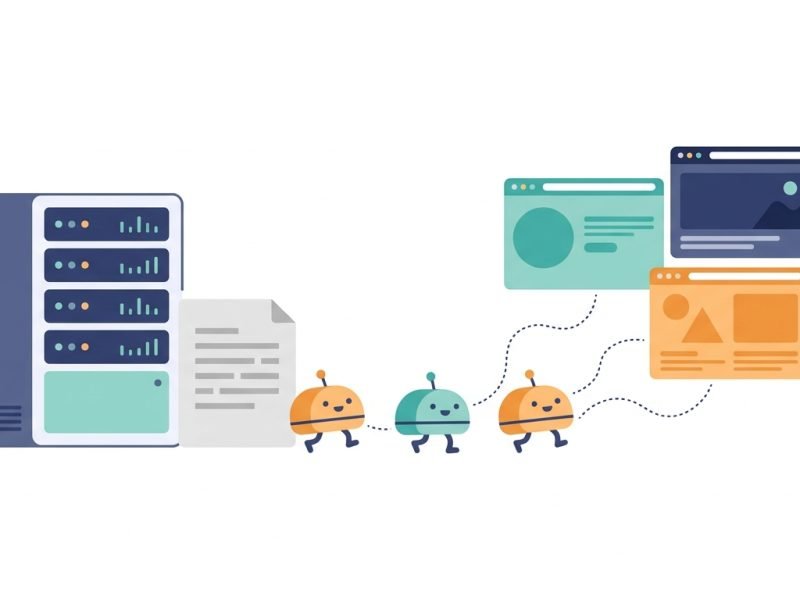
Two traps here. First, a lot of UK sites picked up a blanket AI-bot block during the 2023 and 2024 scraping panic, often added by a developer or a security plugin without anyone deciding it as policy. If you want to appear in AI answers, that block is the reason you do not. Second, robots.txt is only half the story: WAF rules at Cloudflare, SiteGround or similar can return a challenge page to these bots while robots.txt says yes. Test it properly by requesting a live page with each bot's user agent string and checking you get a 200 with real HTML, not a challenge or a 403. An llms.txt file is no substitute for either check. In 30 days of our own server logs, bots from OpenAI, Anthropic and Perplexity made more than 6,000 requests to our site and none of them opened our llms.txt, which we cover in what our server logs reveal about llms.txt.
Check 3: score your content for extractability
Take your ten most commercially important pages and, for each H2 section, ask a blunt question: does the first sentence after this heading answer the heading, or does it warm up to the answer? Answer engines lift passages. A section that opens with "When it comes to choosing a web designer, there are many factors to consider" gives them nothing to lift. One that opens with "A small business website in the UK typically costs between GBP 2,000 and GBP 8,000" is directly quotable.
Run through this quickly on each page:
- Does every H2 and H3 read as a question or a clear statement of what follows
- Is there a direct, self-contained answer in the first two sentences of each section
- Are numbers, prices and timeframes stated explicitly rather than implied
- Would each answer still make sense if lifted out of the page entirely
- Is there a genuine FAQ section covering the awkward questions, not just the flattering ones
That last point is where most sites lose. Our analysis of which content formats get picked up in AI search found the same pattern repeatedly: self-contained, question-led blocks get cited, narrative marketing copy does not.
Check 4: validate your structured data properly
Run each priority page through Google's Rich Results Test and Schema.org's own validator. You are not just checking for errors, you are checking for absence. The most expensive schema failure is the silent one, where a plugin renders an FAQ section perfectly for readers but never outputs the underlying markup, so you get zero credit from anything that reads the page programmatically. Schema.org's FAQPage specification sets out what the markup has to contain, and Google's guidance on how its AI features use page content explains what it does with it.
At minimum, confirm you have valid Organisation markup on the site, LocalBusiness if you serve a defined area, Product with real prices on ecommerce pages, and FAQPage wherever you genuinely answer questions. Do not add markup describing content that is not on the page, which is a policy breach and, more practically, teaches the model you are unreliable.
Check 5: audit your entity consistency
This is the least glamorous part of an AEO audit and often the highest yield. Pull up every place your business describes itself: the website footer, the about page, Companies House, your Google Business Profile, LinkedIn, industry directories, old press releases. Then check whether they agree on your legal name, trading name, address, founding year, service list and price points.
UK businesses are unusually prone to this problem because of the gap between the registered entity at Companies House and the trading brand. If your Companies House record says one thing, your website says another and a directory listing from 2019 says a third, a language model has three conflicting facts and no way to arbitrate. It will either hedge or pick the loudest source, which is frequently not you.
Check 6: assess third-party corroboration
Search your brand name and read what comes back from sources you do not control: reviews, press mentions, directory entries, forum threads, supplier pages. Models lean on independent confirmation, so the practical question is whether anything outside your own domain confirms what you claim. If your site says you specialise in ecommerce for UK manufacturers and nothing anywhere else says so, that claim carries very little weight. Where nothing outside your domain backs you up, the next job is earning those mentions, and our guide to getting ChatGPT and Perplexity to mention your brand sets out where to start.
What an answer engine optimisation audit cannot tell you
Being straight about the limits is what separates a useful audit from a sales exercise. There are things this process genuinely cannot establish, and anyone telling you otherwise is selling something.
- It is not a ranking report. Answer engines do not have stable positions. Ask the same question twice and you can get different sources. Treat your baseline as a directional sample, not a measurement.
- It cannot attribute revenue. Most AI referrals arrive with no referrer or a generic one, and a large share of AI influence ends in a direct visit or a branded search days later. Our guide to tracking AI search traffic in GA4 covers what you can and cannot see analytically.
- It cannot prove causation. If citations improve after you fix your schema, the schema may have helped, or the model may have been updated. Change one thing at a time and be patient.
- It does not transfer between engines. Perplexity leans on fresh web retrieval, ChatGPT blends retrieval with training data, Google blends AI Overviews with its classic index. Winning in one is not winning in all.
How often to re-run the audit
Quarterly is right for most UK SMBs. The technical checks (crawler access, structured data) only need repeating when something changes on the site, but they should be re-run after any migration, replatform, theme change or security plugin installation, because those are exactly the events that silently reintroduce blocks. The citation baseline is the part that needs a fixed quarterly rhythm, with identical prompts each time, or you will have no idea whether anything moved.
Build the technical half into your existing routine rather than treating it as a separate project. If you already work through a technical SEO checklist, the crawler and schema checks belong in the same pass.
Three mistakes that make an AEO audit useless
We see the same three failures repeatedly when businesses bring us an audit they ran themselves.
- Auditing without a baseline. Fixing things first and measuring afterwards means you can never demonstrate a return, which means the work loses its budget at the next review.
- Treating the score as the deliverable. Several tools output a single AEO score. A score is not a diagnosis. The useful output of an answer engine optimisation checklist is a ranked list of specific defects with an owner against each one.
- Skipping the boring checks. Entity consistency and crawler access are dull and unglamorous, and they are where the actual blockers live. Content restructuring is the fun part and rarely the binding constraint.
If you would rather not run this yourself, our answer engine optimisation service covers the full audit, the fixes and the quarterly re-measurement, and it starts with exactly the baseline described above. For the wider picture of how this connects to your organic performance, see our SEO services, and for a broader strategic view there is our UK playbook for AI search optimisation.
FAQ
What is an answer engine optimisation audit?
An answer engine optimisation audit is a structured check of whether AI answer engines such as ChatGPT, Perplexity, Gemini, Copilot and Google's AI Overviews can reach your content, understand it and cite you when answering questions in your market. It covers six areas: a citation baseline, AI crawler access, content extractability, structured data, entity consistency and third-party corroboration.
How is an AEO audit different from an SEO audit?
A traditional SEO audit asks whether your pages can rank for queries. An AEO audit asks whether your content can be extracted, trusted and attributed by a language model. The technical overlap is real (both care about crawlability and structured data) but the content criteria differ: SEO rewards depth and relevance, while answer engines reward self-contained, directly quotable passages backed by consistent facts.
Can I run an AEO audit without paying for a tool?
Yes. The full first pass described in this guide uses only a browser, a spreadsheet, your robots.txt file and free validators such as Google's Rich Results Test. Paid AI-visibility platforms mainly add scale and automated tracking over time. They are useful once you are measuring regularly, but they are not needed to find your first round of blockers.
How long does an answer engine optimisation audit take?
A focused first pass on a small business site takes roughly half a day: an hour or two for the citation baseline across ten to fifteen questions, an hour on crawler and firewall checks, and two to three hours reviewing content structure, schema and entity consistency. Larger sites with many templates take proportionally longer, mostly in the structured data review.
How often should I repeat the audit?
Quarterly for the citation baseline, using identical prompts each time so results stay comparable. The technical checks should additionally be re-run after any site migration, replatform, theme change or new security plugin, because those events are the most common cause of AI crawlers being silently blocked again.
Which AI crawlers should I allow in robots.txt?
If you want to appear in AI answers, allow GPTBot and OAI-SearchBot (OpenAI), Google-Extended (Gemini and AI features), PerplexityBot, ClaudeBot and Bingbot, which still feeds Copilot. Blocking Google-Extended does not remove you from AI Overviews, but blocking Googlebot removes you from Google entirely, so check exactly which agent a rule targets before changing it.