Search is still the highest-intent, lowest-cost channel most UK businesses have access to, but only if you stop collecting tactics and start running a sequence. The eight SEO strategies below are the ones that reliably increase website traffic for small and mid-sized UK companies, ordered roughly by how fast they pay back.
Why "more SEO" rarely works (and what does)
Most sites that "do SEO" do a little of everything: a meta tag tweak here, a blog post there, an alt text tidy-up, and then wonder why the traffic line stays flat. The problem is not effort, it is that the effort does not compound. These strategies are designed to stack. Keyword and intent decisions set the targets, on-page work recovers equity you have already paid for, content depth earns links, technical hygiene removes drag, and measurement tells you which lever to pull harder. Pull one in isolation and it does twice the work for half the result. The 80/20 rule of SEO is real: most of your future organic revenue will come from a small number of these levers pulled properly, not from all eight pulled gently.
One honest caveat before you start. In the UK, the broad head term "how to increase website traffic" is answered first by a Google AI Overview, then by SEO software publishers, Shopify's own guide and a handful of agency blog posts, several of them written between 2020 and 2022. The AI Overview takes the easy answers, and the pages beneath it rank on age and links as much as on quality. That is fine, because those are not the searches that produce customers. The money is in the specific, lower-volume queries your buyers actually type, and those are very winnable. Aim there.
Six SEO strategies that do the heavy lifting
1. Keyword research grounded in real demand
Every campaign that works starts with a keyword list backed by verified UK search volume, not a brainstorm of phrases that sound right. Pull volume, difficulty and CPC from Google Keyword Planner, your own Search Console impression data, and a tool such as Ahrefs or Semrush. Then sort by intent and prioritise the lowest-difficulty term that matches a real research or buying stage. The cheapest wins are usually long-tail phrases of three or more words with modest UK volume and a difficulty score under 30. They look boring on a spreadsheet and convert well in practice.
2. Match each page to a single search intent
Google ranks pages, not sites, and it ranks them on how closely they match what the searcher wanted. A page chasing both "what is SEO" and "SEO services UK" will lose to two separate pages that each do one job. For every target keyword, look at the current top 10 and let it tell you the intent: informational queries want a guide, commercial queries want a service or comparison page, transactional queries want a product or quote page. If the results are all guides, a sales page will not crack it. Build the page type Google has already chosen.
3. On-page optimisation, done end to end
On-page SEO is the cheapest and fastest lever you have. For each page, work the primary keyword into the title tag (under 60 characters), the H1, the first 100 words, the URL slug and one H2. Write a meta description under 155 characters that earns the click by leading with the benefit. Use H2 and H3 headings to structure the page for skim-readers and crawlers alike, and give every image descriptive alt text. This is unglamorous work that routinely moves pages several positions on its own.
4. Content that genuinely answers the question
Thin or generic content is the most common reason a page stalls on page two. Aim for real depth on commercial pages, structured around the questions a customer asks before buying, and use lists, tables and step-by-step instructions so it can be skimmed. Read the People Also Ask box for your target query and answer everything the searcher is likely to wonder next. That is how you become the page that does not send someone back to Google. If the writing itself is the bottleneck, our guide to SEO copywriting covers how to structure a page that answers the question and still sells.
5. Internal links that route authority intentionally
Internal linking is the most underused lever on UK SMB sites, and it costs nothing. Every blog post should link to two or three related posts and at least one service or product page, using descriptive anchor text ("ecommerce SEO services" beats "click here"). Build hub-and-spoke clusters: one pillar page covers the broad topic and supporting posts each take a sub-topic and link back. This concentrates authority on the page you actually want ranking, rather than spreading it evenly across pages you do not care about.
6. Technical SEO done once, maintained quarterly
You do not need a dedicated technical specialist if your site runs on a competently configured WordPress or Shopify install, but you do need a quarterly pass for broken links, slow pages, indexability errors, missing structured data and duplicate content. Run PageSpeed Insights on your top 10 commercial pages and fix anything in the red, then clear every error in the Search Console coverage report. Our guide to SEO on WordPress sets out what a well-configured install looks like, and ongoing WordPress maintenance keeps it that way. Our technical SEO checklist sets out the full quarterly pass, and a site that crawls cleanly ranks faster.
Strategy 7: Build authority through links and digital PR
Links from other reputable sites still carry real weight, but the rules have shifted. A single mention in a recognised industry publication, a trade association directory or a trusted UK trade body now outperforms a hundred low-quality directory submissions. Concentrate on three sources: digital PR (newsworthy data, surveys or expert commentary that journalists will actually use), genuine contributions to industry sites in your niche, and unlinked brand mentions that you politely ask to have linked. Audit your backlink profile every six months, and disavow only spam you did not earn yourself. Never touch anything ambiguous.
The cheapest legitimate tactic for most UK SMBs is producing one piece of original data per quarter: a customer survey, a freedom of information request, or a benchmark across your sector, pitched to two or three trade publications. One placement does more for rankings than a year of generic outreach, and it gives your sales team something to talk about as well.
Strategy 8: Measure in Search Console and act on what it says
The strategies above only compound if you measure them. The minimum stack is Google Search Console, Google Analytics 4, and a recurring calendar reminder to actually open both. Watch four numbers, all defined in Google's Search Console Performance report documentation: impressions (is Google showing your pages at all?), average position (where on the results page?), click-through rate (are your titles and descriptions earning the click?), and organic conversion rate in GA4 (does any of this turn into revenue?).
Then act on what you see, because each pattern has a standard response:
- Position 8 to 15 on a target query. This is a refresh-and-republish candidate, and usually the single fastest way to add organic traffic. Add depth, tighten the intent match, republish.
- Plenty of impressions, click-through rate under 2%. The page ranks but the listing does not appeal. Rewrite the title tag and meta description before touching the body copy.
- No impressions at all, six months after publishing. The keyword choice or the intent match is wrong. Rethink the page rather than tweaking it.
- Impressions rising, position static around 40 or worse. Google understands the topic but does not rate the page. This is usually a depth or authority problem, not an on-page one.
- Impressions at zero after a URL change. Run the new address through URL Inspection in Search Console. A renamed or moved page can sit undiscovered for weeks, even with a redirect in place and an updated sitemap, so request indexing on the day you change a slug rather than a month later.
Traffic is only the middle of the story. Our guide to measuring SEO ROI covers how to connect those four numbers to enquiries and revenue, which is what decides whether the programme is worth continuing.
Local SEO: the traffic most UK small businesses leave on the table
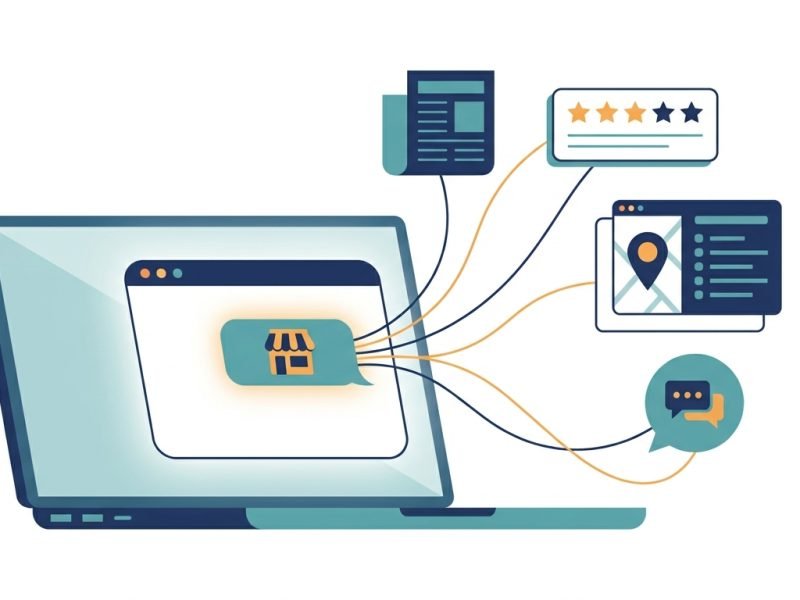
If you serve customers in a town, a county or a region, one of the biggest sources of search traffic is not your website at all. It is your Google Business Profile, which can appear in the map results for searches with local intent and sends people to your site, your phone line and your door. Google's own guidance on improving local ranking says local results are mainly based on relevance, distance and popularity. You cannot move your premises, but you can work on the other two.
- Relevance: complete every field on the profile, choose the most specific primary category, list your services, and keep opening hours accurate, including bank holidays.
- Popularity: ask every satisfied customer for a review, reply to all of them, and earn genuine mentions from local press, suppliers and trade bodies.
- Consistency: make sure your business name, address and phone number match exactly across your website, your profile and the directories that matter in your sector.
- Location pages that deserve to exist: one page per area you genuinely serve, with something specific to say about each, beats a dozen near-identical pages with the town name swapped.
Our guide to local SEO for small businesses goes deeper, and the local SEO checklist turns it into a list you can work through in an afternoon. If you only sell online to customers across the UK, skip this section: it will not move your numbers.
How other channels make SEO traffic grow faster
SEO is the subject of this guide, but the businesses that grow organic traffic fastest rarely run it on its own. Other channels feed it in three specific ways.
- Paid search tells you which keywords are worth ranking for. A few weeks of Google Ads on a small budget shows, through the search terms report, most of the searches that actually turn into enquiries, before you spend months building pages for them. It is the cheapest keyword validation available, and the terms that convert become your SEO targets. Our Google Ads management often runs alongside SEO for exactly this reason.
- Email and social get new pages seen in their first week. A new guide that nobody visits earns no shares and no links. Sending it to your mailing list and posting it where your customers already spend time brings the first readers, and occasionally the first links.
- Digital PR serves every channel at once. The original data you produce for journalists under strategy 7 also works as social content, email content and sales material, so one piece of research pays back several times.
It works in reverse as well. Pages that rank well can lower your paid costs, because you can stop bidding on terms you already win organically, and they give social and email something worth sending people to. Treat the channels as one system, and judge SEO on the traffic it adds to that system rather than in isolation.
How to sequence these strategies for fastest results
If you have limited time and budget, which describes most UK SMBs, work them in this order: technical SEO to clear the drag, then keyword research and intent mapping to set the targets, then on-page optimisation of your top 10 commercial pages, then content depth on those same pages, then an internal linking pass across the site, then a publishing cadence for new content, and only then links and digital PR. If you serve a local area, run the Google Business Profile work from the local SEO section alongside the first step, because it is quick and pays back early.
That order usually produces measurable ranking gains within eight to twelve weeks, because the first three steps recover ranking equity you have already paid for before you spend anything on new work. Content production is often where SEO budgets go first because it is the most visible work, but it is also the slowest to compound. Optimise what you already have first. Before any of it, though, it is worth checking you are not undermined by one of the common SEO mistakes that quietly cap rankings, because no strategy outruns a broken foundation.
How to choose which pages to work on first
The order above tells you which kind of work comes first. Within each step, score every candidate page or keyword on four questions and start with the highest total:
- Business value. Does a visitor to this page buy something you sell? A service or product page beats a general guide every time.
- Current position. Pages already sitting between positions 8 and 20 in Search Console move fastest, because Google already considers them relevant.
- Competition. Look at who ranks above you. Large publishers and software companies are slow to displace. Small sites with thin, dated pages are not.
- Effort. A title rewrite takes ten minutes and a new pillar page takes weeks. When two pages score the same, do the cheaper one first.
What realistic traffic growth looks like on a UK SMB site
Expectations cause more abandoned SEO programmes than results do, so it is worth being concrete. On an established UK site with some existing authority, on-page and technical fixes to pages already ranking on page two typically show movement in four to eight weeks. New content aimed at long-tail terms usually takes three to six months to settle into a stable position. Link-driven gains on competitive commercial terms run to six to twelve months. A brand-new domain should assume very little for the first six months regardless of how good the work is, because Google needs time to trust the site at all. If that is you, our new website SEO checklist gets the foundations right from launch.
Growth also arrives unevenly. A typical pattern is months of apparently flat traffic while impressions climb quietly, followed by a step change when a cluster of pages crosses from page two to page one at roughly the same time. If impressions are rising and clicks are not, the programme is working and simply has not crossed the threshold yet. That is the moment most businesses give up, and it is precisely the wrong moment.
Search is also changing shape. A growing share of queries now resolve inside an AI Overview or a chatbot answer, which is why it is worth pairing these fundamentals with generative engine optimisation so you are cited by answer engines as well as ranked by Google. Google's documentation on AI features and your website is clear that the same SEO best practices apply to AI Overviews and AI Mode, with no additional requirements or special optimisations, so the eight strategies above are your AI search strategy too. Google's own guidance on creating helpful content and its SEO Starter Guide remain the canonical references for what it is actually rewarding.
If you would rather not piece all eight together yourself, our SEO services follow exactly this sequence on every UK engagement. For smaller operations, our guide to small business SEO narrows the priorities further, how SEO actually works is the place to start from zero, and what a digital marketing agency does is worth reading before you hire anyone.
Frequently asked questions
How long does SEO take to increase website traffic?
On an established UK site, on-page and technical fixes to pages already ranking on page two usually show movement in four to eight weeks. New content targeting long-tail terms takes three to six months to settle, and competitive commercial terms that need links run to six to twelve months. A brand-new domain should expect very little in the first six months while Google builds trust in the site.
Which SEO strategy increases traffic fastest?
On-page optimisation of pages that already rank on page two. Those pages have proven relevance and existing impressions, so tightening the title tag, the intent match and the depth often moves them several positions within weeks. It is far quicker than publishing something new, because you are recovering equity you have already paid for rather than starting from nothing.
Do I still need backlinks to grow organic traffic in 2026?
Yes, but far fewer and of much higher quality than a decade ago. One mention in a recognised trade publication or industry body now beats a hundred directory submissions. For most UK SMBs the practical route is producing one piece of original data a quarter, such as a customer survey or a sector benchmark, and pitching it to two or three trade titles.
How can I increase website traffic for free?
Most of the strategies in this guide cost time rather than money. Rewrite the title tags and meta descriptions on pages already ranking on page two, add internal links from your strongest pages to the ones you want to rank, refresh your best-performing content, complete your Google Business Profile if you serve a local area, and send every new page to your email list. Search Console, Google Analytics 4 and PageSpeed Insights are all free, and between them they show you where to start.
Is SEO worth it compared with paid ads?
They solve different problems. Paid search buys traffic immediately and stops the day you stop paying. SEO takes months to build but the traffic keeps arriving without a per-click cost, and it compounds. Most UK SMBs are best served running paid ads for immediate lead flow while SEO matures underneath, then reducing paid spend on terms where they have earned an organic position.
What is the 80/20 rule of SEO?
The idea that a small share of the work produces most of the results. In practice that 20% is targeting validated keywords, matching search intent, optimising on-page elements properly, and writing content that genuinely answers the question. Exhaustive technical audits, mass directory submissions and schema for every page type produce marginal gains by comparison. Find your high-leverage 20% and spend most of your time there.