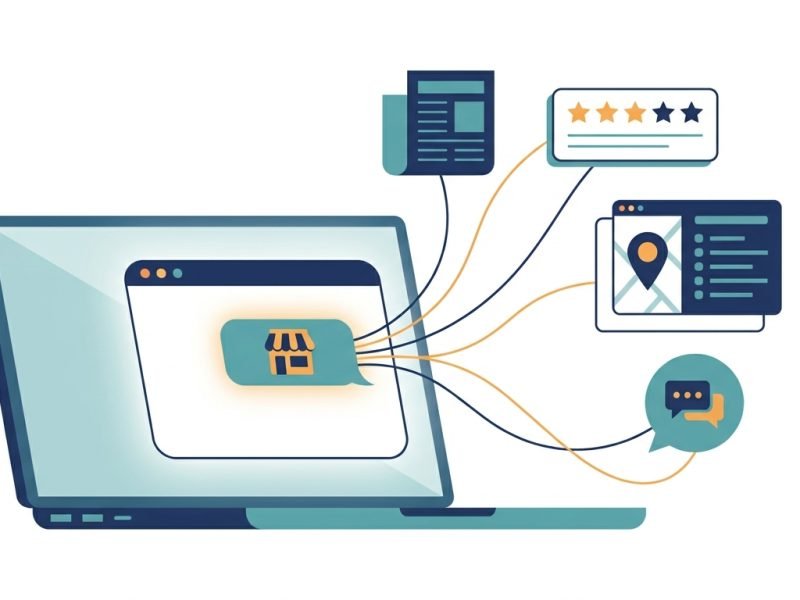
SEO for small business is the work of getting your website in front of people who are already searching Google for what you sell, without paying for every click. This guide sets out what that involves in 2026, which parts you can do yourself for free, what it costs when you pay for help, and the order to do it in.
Why SEO matters more for small businesses than for big ones
There were 5.7 million private sector businesses in the UK at the start of 2025, and 5.64 million of them employed fewer than 50 people, according to the Department for Business and Trade's business population estimates. Most of them compete for the same local and niche searches you do, and very few can outspend a national brand on advertising.
That is exactly why search matters. Large brands can buy attention: they can keep Google Ads, Meta and brand campaigns running indefinitely and keep paid traffic flowing. A small business cannot, because every pound of advertising stops working the moment the campaign pauses. Organic search works the other way round. A page that ranks for "industrial cleaning services Birmingham" or "vegan birthday cake London" keeps producing enquiries every week without a daily budget behind it, and nobody can pay Google to rank higher in the organic results. That is also why the periodic claim that SEO is dead usually comes from people measuring the wrong thing.
Position matters more than most owners expect. In Backlinko's analysis of four million Google results, the top three organic results took 54.4% of all clicks, and the first result alone averaged a 27.6% click-through rate. Page two barely registers. So the goal is not "being on Google". It is ranking near the top for a small number of searches that bring buyers.
There is one caveat. SEO is slow. Most small businesses see meaningful traffic gains between months three and six, and steady lead flow between months six and twelve. If you need enquiries this week, run Google Ads. If you want customers who cost less to win in twelve months' time, start SEO now. The businesses that win stop treating the two as alternatives and run them together.
The six things SEO actually does for a small business
1. Captures buyers at the moment of decision
Someone searching for "emergency plumber Leeds" is not browsing. They have a leak, they want a phone number, and they will call one of the first few businesses they see. SEO puts your business in front of those people at the moment they are ready to buy, which no interruption channel can do as cheaply.
2. Removes the recurring cost of paid clicks
Every Google Ads click costs you money, and once you stop paying the traffic stops. A page ranking organically for the same search keeps delivering clicks for months or years at no cost per click. In sectors where clicks are expensive, such as legal, finance and the trades, every enquiry that arrives organically is one you did not pay an auction price for.
3. Builds trust that ads cannot buy
Buyers can see which results are ads, because Google labels them as sponsored. An organic listing, especially one backed by strong reviews in the map results, reads as earned rather than bought. For service businesses where trust is what closes the sale, that difference shows up in your enquiry rate.
4. Drives steadier, more predictable lead flow
Once a page ranks, the traffic is steady enough to plan around. You can forecast enquiries, plan capacity and hire ahead of demand. Paid campaigns depend on auction prices that move daily and budgets that can be paused at any moment. Organic search is the closest thing a small business has to a dependable pipeline.
5. Reaches buyers who will never take a sales call
Most buyers now research alone. They search a problem, read a couple of guides, compare two or three providers and only then get in touch. They ignore cold calls and scroll past display ads. If your business is missing from those searches, it is missing from the shortlist.
6. Compounds without compounding cost
Every useful page you publish, every genuine link you earn and every internal link you add strengthens the whole site. By year two, a small business with disciplined SEO has dozens of pages bringing in steady traffic, each one supporting the others. That compounding effect is unique to organic search.
What "doing SEO" actually involves in 2026
SEO has three parts, and neglecting any one of them limits what the other two can achieve. The basics have not changed much in a decade, but the bar for content has risen, and Google now shows AI Overviews and AI Mode answers alongside the traditional results. Google's own guidance on AI features is clear that there are no additional requirements to appear in them: the same SEO best practices apply. We explain how we approach all three parts on our SEO services page.
1. Technical SEO
This is everything Google needs to find, render and index your pages without friction. The essentials in 2026:
- Page speed. Google's Core Web Vitals guidance says Largest Contentful Paint should happen within 2.5 seconds of a page starting to load for a good user experience. Slow pages lose visitors before they lose rankings, so treat speed as a conversion problem as much as an SEO one.
- Mobile-first design. Google predominantly crawls and indexes the mobile version of your site. If your mobile pages hide content or links that the desktop version shows, the mobile version is the one being judged.
- Clean URL structure. Descriptive paths like
/seo/small-business-seo/beat parameter strings and auto-generated numbers every time. - Structured data where it earns something. LocalBusiness, Organization and Product markup helps Google understand who you are and what you sell. Two things have changed, though. Google stopped showing FAQ rich results on 7 May 2026, and Google's review snippet rules do not allow star ratings for reviews a business publishes about itself. Add markup for accuracy, not decoration.
- Crawlable architecture. A logical XML sitemap, no orphan pages and no broken links on your own site.
The Google SEO Starter Guide covers the technical fundamentals in plain English. Read it before you pay anyone for an "audit", then work through our technical SEO checklist once a quarter.
2. On-page SEO
This is the work of telling Google, and your reader, what each page is about. It is mostly writing, mostly free, and mostly neglected. The habits that matter:
- Use the main search term naturally in the title tag, the H1, the opening paragraph and at least one subheading.
- Write helpful, specific, original copy. 1,200 words of useful detail beats 3,000 words of filler.
- Answer the questions buyers actually ask. Mine the "People also ask" box, forum threads and your own enquiry inbox for them.
- Give every important page a clear next step: a phone number, a form or a price.
- Use internal links to point authority at your most valuable pages.
- Add descriptive alt text to images and serve them in modern formats such as WebP or AVIF.
Our guide to SEO copywriting shows how to write pages that rank and still read well.
3. Off-page SEO
This is everything that happens away from your own site, and mostly it means links. A link from a relevant, trusted UK site tells Google that someone independent vouches for you. The realistic ways a small business earns them:
- Local press coverage and features in trade publications.
- Listings from trade bodies and professional associations you genuinely belong to, and your local Chamber of Commerce.
- Supplier, partner and manufacturer pages, such as "approved installer" or "where to buy" lists.
- Articles on genuinely relevant industry sites, not paid "guest post" networks.
- Journalist request services such as ResponseSource, where reporters look for expert comment.
- Original research or a clear expert opinion, which is still the most reliable way to earn editorial coverage.
What does not work: buying links, link swaps, comment spam, blog networks and expired-domain redirects. Google's spam policies class buying or selling links for ranking purposes as link spam, and recovering from a penalty costs far more than the links ever did.
Local SEO: the quickest win if you serve an area
If your business serves a defined area (a takeaway, a solicitor, a roofer, a clinic), local SEO is where your first hours should go. Google's guidance on improving local ranking says local results are mainly based on relevance, distance and popularity. You cannot move your premises, but you can work on the other two.
- Google Business Profile. Claim and verify it, complete every field, choose the most specific primary category, add real photos and ask every satisfied customer for a review. Reply to all of them, good and bad.
- Consistent business details. Your business name, address and phone number should match exactly across your website, your profile, Bing Places and the directories that matter in your sector.
- Location pages that deserve to exist. One page per area you genuinely serve, each with something specific to say about it (jobs completed there, local rules, response times). Google's spam policies treat near-identical pages built only to rank for each town as doorway abuse.
Local results also appear in the map pack, the block of three businesses that sits above the organic listings for many local searches. For a service-area business, appearing there is often worth more than any organic position. Our local SEO playbook for small businesses goes deeper, and the local SEO checklist turns it into a list you can work through in an afternoon. If you sell online to customers across the UK, skip this section and put the time into your product and category pages instead.
Free SEO tools every small business should use
You do not need a paid software stack to start. These free tools cover most of what a small business needs:
- Google Search Console. The only tool whose data comes directly from Google Search: which searches show your pages, where they rank, how often they are clicked and which pages are indexed. Google's guidance on third-party SEO tools points out that other tools do not have access to its internal ranking data, and strongly encourages using Search Console.
- Google Analytics 4. Shows what visitors do once they arrive, including enquiries and sales once you set them up as key events.
- Google Business Profile. Its performance view shows how people found your profile and how many called, asked for directions or visited your website.
- Google Keyword Planner. Free inside a Google Ads account. Google's help page describes it as a way to discover keywords related to your business and see estimates of how often they are searched.
- PageSpeed Insights. Tests any page's speed and Core Web Vitals on mobile and desktop.
- A desktop crawler. Screaming Frog's SEO Spider crawls up to 500 URLs free, enough for most small business sites, and flags broken links, missing titles and redirect chains.
Between them, these answer the three questions that matter: is Google finding my pages, what are people searching to reach them, and do those visits turn into customers?
SEO for small business examples: what the work looks like in practice
The principles are the same for every business, but the first moves differ. Here are three illustrative examples. The businesses are hypothetical; the approach is how we would start.
A local trade: a heating engineer covering one city
The searches worth winning are things like "boiler repair [city]", "emergency heating engineer [city]" and "boiler service [district]". The first moves are a complete Google Business Profile with the right primary category, one page per core service (repairs, servicing, installation), a small number of area pages for the districts genuinely covered, and a steady flow of reviews. The measure of success is calls and form enquiries from the profile and the site, not traffic.
A professional services firm: an accountancy practice
The searches worth winning are "accountant for contractors", "small business accountant [town]" and the questions clients already ask by email, such as whether they need to register for Self Assessment. The first moves are a service page for each client type, a clear page explaining how the firm prices its work, and a handful of genuinely useful guides. The measure of success is consultation requests, and which guides lead to them.
An online shop selling across the UK
The searches worth winning are product and category terms with buying intent, such as "oak floating shelves" or "personalised dog collar". The first moves are unique copy on every category page, complete product information (price, availability, delivery), product structured data, and fixing the duplicate pages that filters and variants create. The measure of success is revenue from organic search by landing page. Local SEO barely matters here; category pages do.
How long SEO takes and what to expect
A realistic timeline for a small business starting from a site with little authority:
- Months 1 to 3: Foundations. Technical fixes, keyword research, a content plan and the Google Business Profile sorted. Little visible change in traffic yet.
- Months 3 to 6: First page-one positions for specific and local searches. Enquiries begin to trickle in, and reviews start to build.
- Months 6 to 12: Compounding. The pages published in the first months start ranking properly, and lead flow becomes more predictable.
- Year 2: The site has authority. New pages rank in weeks rather than months, and SEO is usually the cheapest lead source you have.
Anyone promising page-one rankings in 30 days is selling you something other than SEO. Google's own advice on hiring an SEO is blunt: no one can guarantee a #1 ranking on Google, and you should be wary of anyone who claims a "special relationship" with Google.
What SEO costs a small business in the UK
The ranges below match our full UK SEO pricing guide, which explains what drives the difference between a £600 quote and a £6,000 one.
- £300 to £1,200 per month: local SEO for one or two areas. Google Business Profile work, a handful of service and location pages, technical fixes and monthly reporting. Realistic for a tradesperson, clinic, salon or single-site service business.
- £1,200 to £3,000 per month: multi-location or regional campaigns for businesses covering a county or region, or running several branches.
- £2,000 to £5,000 per month: national campaigns for UK-wide service providers and B2B firms, with regular content and digital PR.
- £2,000 to £8,000 per month: ecommerce, where large catalogues bring ongoing technical work.
Most small and mid-sized businesses land between £1,000 and £2,500 a month. A one-off technical audit typically costs £500 to £3,000, which is a sensible first step if you plan to do the work yourself. Our SEO packages page sets out what belongs in a package at each level and how to tell a real scope from a tick-list.
What you should never pay for: "10 backlinks a month for £99", retainers with no breakdown of what is delivered, anyone who charges by ranking position rather than by work done, or a contract that locks you in for 12 months with the notice period buried on page 8.
Doing it yourself, a freelancer or an agency?
Doing it yourself works when someone in the business can give it a few hours every week, is comfortable writing about what you do, and can be patient with slow results. The advantages are deep product knowledge and no fees. Local SEO in particular is well within reach of any owner.
A freelancer works when you need specialist hands for a defined job, such as a technical audit or a website migration. UK freelancers typically charge £40 to £150 an hour, or £500 to £1,500 a month on retainer.
An agency works when you want technical work, content and reporting handled together, have nobody trained in SEO internally, and can commit a realistic budget for at least six months. You get established processes, paid tools and a team that has seen your competitors' tactics before. Our guide to the best SEO agencies in the UK sets out what separates a good agency from a poor one, and the professional SEO services buyer's guide covers the questions to ask before you sign.
The wrong call is to buy the cheapest package on the market and expect results. At £99 or £150 a month the skilled hours are not there, the work is usually automated, and when nothing ranks it is easy to conclude that SEO does not work for your business. It does. It was underfunded.
Measuring whether your SEO is working
The four measures that matter, in order:
- Qualified enquiries from organic search. Tracked in your CRM or contact form. This is the only measure that pays the bills.
- Organic traffic to commercial pages. Service pages, location pages and product pages, not blog traffic.
- Positions for high-intent searches. "[Service] [town]" and similar, checked monthly in Search Console.
- Impressions and click-through rate in Google Search Console. Rising impressions tell you Google is showing your pages more often. Click-through rate tells you whether your titles and descriptions earn the click.
Treat three numbers with care: total traffic without a quality filter, rankings for terms nobody searches, and bounce rate on its own. In Google Analytics 4, bounce rate is simply the percentage of sessions that were not engaged (an engaged session lasts longer than 10 seconds, includes a key event or has two or more page views), so a contact page that does its job quickly can still show a high figure. Our guide to measuring SEO ROI shows how to connect rankings to revenue.
Common mistakes that waste a small business SEO budget
The mistakes we see most often when auditing small business sites in the UK:
- Stuffing every page with the same few keywords. It reads badly, converts badly and does nothing for rankings.
- Publishing thin posts that say nothing new. A 400-word post with no original insight is worse than no post at all.
- Ignoring the Google Business Profile. For a local business, it is often the most valuable hour you can spend each month.
- Chasing head terms you cannot win. A one-word term like "plumber" is wanted by every plumbing firm, trade directory and comparison site in the country. "Emergency plumber Newcastle" is smaller, more specific and far more winnable.
- Stopping after three months. SEO compounds, and most of the return arrives after the point where impatient owners give up.
- Buying tools or content on the promise of guaranteed rankings. Google's guidance on third-party SEO services says it does not evaluate them and that using a service or tool does not guarantee ranking success.
We cover the fixes in detail in common SEO mistakes and how to fix them.
AI search and small business SEO
AI Overviews, AI Mode, ChatGPT and Perplexity have changed how some questions are answered, particularly simple informational ones. They have not changed what earns visibility. Google says a page must be indexed and eligible to appear in Search with a snippet to be shown as a supporting link in AI Overviews or AI Mode, and that the same foundational best practices apply. For a small business, the practical consequences are:
- Answer the specific questions your customers ask, clearly and early on the page.
- Keep your business name, address, opening hours and services consistent everywhere they appear online.
- Be wary of anyone selling "AEO" or "GEO" as a separate product with guaranteed results. Google's guidance on third-party tools names those promises specifically.
Our AI search optimisation playbook covers this in more depth.
Where to start this week
If you want to begin today, here is the realistic order:
- Day one: Claim and complete your Google Business Profile, and verify your website in Google Search Console.
- Week one: Run a free crawl of your site to find broken links, redirect chains and duplicate title tags, and check the Page indexing report in Search Console for pages Google has not indexed.
- Week two: Choose your five most valuable commercial searches using Search Console data and Google Keyword Planner. Our guide to SEO strategies that increase website traffic shows how to prioritise them.
- Month one: Rewrite your homepage and core service pages around those searches, and add internal links to and from them.
- Month two onwards: Publish one useful, original page a fortnight, ask for reviews every week, and aim to earn one or two genuine links a month from UK sites relevant to what you do.
That is the minimum viable SEO programme for a small business. It needs the owner's time and judgement, which no agency can supply, but it works.
If you want help with the parts that genuinely benefit from specialists (technical work, content at scale and structured reporting), the Peak Digital SEO services page explains what we do and how we scope it. For the bigger picture, read why SEO is important for business, and if you are starting from zero, our SEO for beginners guide explains the terminology. The Federation of Small Businesses also publishes a beginner's guide to SEO for its members.
Frequently asked questions
How much should a small business spend on SEO per month?
Most UK small businesses that see genuine results spend between £1,000 and £2,500 a month with an agency. Local SEO for one or two areas typically costs £300 to £1,200 a month, while national and ecommerce campaigns usually start at around £2,000. Packages at £99 to £199 a month rarely include enough skilled hours to move rankings, and some rely on automated link building that can do harm. Our UK SEO pricing guide breaks the ranges down.
Can I do SEO myself without hiring anyone?
Yes, if you can give it consistent time. Local SEO (Google Business Profile, reviews and location pages) is well within reach of any owner who can set aside two hours a week, and the core tools (Search Console, Google Analytics, Keyword Planner and PageSpeed Insights) are free. National SEO with regular content is harder to sustain alone unless you already have writing capacity. Many small businesses settle on a hybrid: the owner runs the profile and reviews, and a specialist handles technical work and content.
How long before SEO starts generating leads?
Specific and local searches typically start ranking within three to six months on a technically sound site, and the first organic enquiries usually arrive in months four to six. Competitive national terms take twelve months or more. Anyone promising faster results is either selling ads disguised as SEO or taking shortcuts that put your site at risk.
Is SEO still worth it now that AI Overviews answer questions directly?
Yes. Google says the same SEO best practices apply to AI Overviews and AI Mode, with no special optimisations needed, and a page has to be indexed and eligible to appear in Search to be shown as a supporting link in them. Simple informational searches now send fewer clicks, but commercial searches such as "emergency plumber near me" still send buyers to businesses. The discipline of being cited by AI tools has a name now, and we cover it in our guide to getting your brand cited by LLMs.
What is the difference between SEO and Google Ads?
Google Ads is rented traffic: you pay for every click, and the traffic stops when you stop paying. SEO is owned traffic: you invest in pages and authority, and those pages keep delivering clicks for months or years afterwards. For most small businesses the right answer is both, with ads for immediate enquiries and for testing which searches convert, and SEO for a lower long-term cost per customer. See our Google Ads management and digital marketing services for how the two work together.
Should I do local SEO or national SEO?
If your customers are within a defined area (you serve Bristol but not Leeds), local SEO comes first, starting with your Google Business Profile. If you ship products or deliver services across the UK, national SEO is your priority and the map pack barely matters. Most small businesses are firmly in the local camp and should resist chasing national head terms until their local presence is solid.